Home / Blog / Shopify vs. Custom Ecommerce Development: Pros and Cons
Compare Shopify vs. custom eCommerce development to find the right solution for your business. Explore the differences in cost, customization, scalability, maintenance, and launch time to understand which platform best fits your needs. Discover when Shopify is the ideal choice for a quick, cost-effective launch and when custom eCommerce development offers greater flexibility for complex workflows, integrations, and long-term growth.
26 Oct, 2026
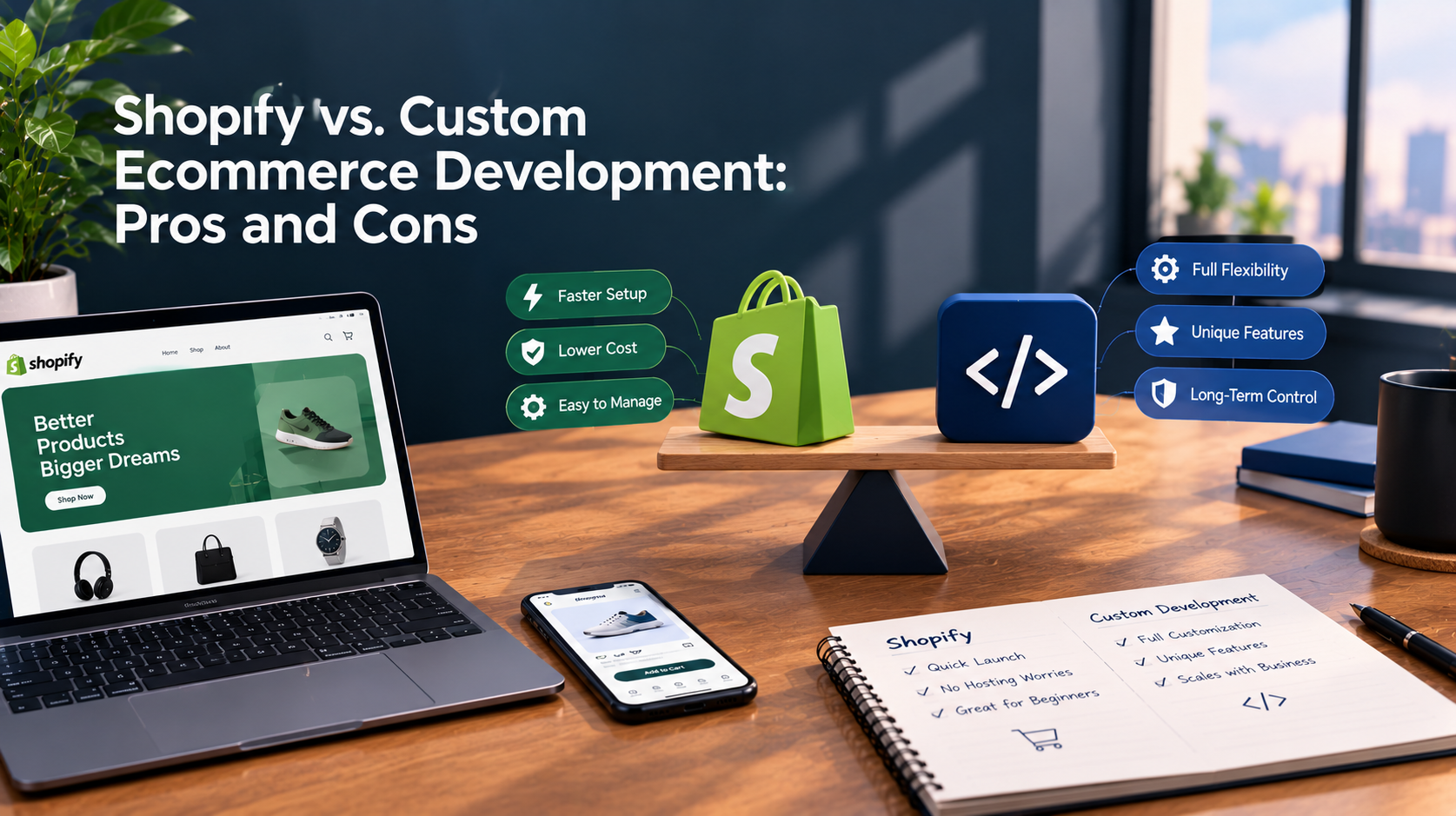
Choosing between Shopify and a custom-built ecommerce platform usually comes down to one question: does the business need to move fast on a proven system, or does it need something built around a process that off-the-shelf software can't handle? Both paths can support a serious online store; the right one depends on budget, technical requirements, and how much control the business actually needs over the backend.
Custom e-commerce development means building the storefront, checkout, and backend logic from the ground up (or heavily modifying an open-source framework) instead of using a hosted platform's built-in tools. It gives a business full control over how the store looks, how it integrates with internal systems, and how it handles unusual business logic things like complex pricing tiers, custom inventory rules, or a checkout flow that doesn't fit a standard template.
Shopify, by contrast, is a hosted platform. The infrastructure, security, and core checkout are managed by Shopify, and businesses build on top of that using themes, apps, and Shopify's own APIs.
Shopify's subscription plans keep upfront costs predictable, but the real cost often comes from apps. Stores that need advanced features, subscriptions, custom filtering, loyalty programs frequently end up paying for several monthly app subscriptions on top of the base plan, and those costs scale with traffic and order volume.
Custom development has a higher upfront investment because every feature has to be built rather than installed. The trade-off is that there's no recurring app tax once a feature is built, it's owned outright, which can make custom development more cost-effective over a longer time horizon for stores with complex needs.
This is usually the deciding factor. Shopify covers the vast majority of standard e-commerce use cases well, but businesses with non-standard requirements, custom B2B pricing logic, complex product configurators, unusual shipping rules, or deep integration with an existing ERP often hit walls that apps can only partially solve.
Custom development removes that ceiling. If a business can describe the workflow it needs, it can generally be built. The cost of that flexibility is time and budget.
Shopify stores can go live in weeks using existing themes and apps, which matters for businesses that need to start selling quickly or are testing a new market. Custom builds take longer because the storefront, checkout, and admin tools are all built rather than configured. For businesses on a tight launch timeline, this is often the single biggest factor in favor of Shopify.
Shopify scales well for most growing stores, especially with Shopify Plus for higher-volume merchants. But businesses with very specific technical needs, massive product catalogs, complex multi-warehouse logistics, or highly customized checkout flows sometimes find themselves working around platform limitations rather than with them.
Custom platforms scale exactly as designed, because the architecture is built for the business's specific growth plan from the start. That advantage only pays off if the initial build accounted for future scale; an under-planned custom build can become just as limiting as an off-the-shelf one.
With Shopify, security patches, uptime, and core platform updates are handled by Shopify itself. The business is mainly responsible for managing apps, theme updates, and content.
With a custom platform, hosting, security, updates, and bug fixes are the business's (or its development partner's) responsibility. This gives more control but also means ongoing technical maintenance needs to be budgeted for as a permanent line item, not a one-time cost.
Businesses evaluating either path are usually better served by starting with a clear list of must-have features and constraints before comparing platforms; that list often makes the decision obvious. Teams weighing this decision can review 10Turtle's Shopify development service to see how a build is typically scoped for each approach.
Q1: Is Shopify cheaper than custom e-commerce development in the long run?
Answer: Usually cheaper upfront, but not always cheaper long-term. Recurring app subscriptions can add up for stores with advanced feature needs, while custom development has a higher initial cost but no ongoing app fees for the same functionality.
Q2: Can a Shopify store be migrated to a custom platform later?
Answer: Yes, migration is possible, though it involves moving product data, customer records, and order history, plus rebuilding any custom logic. It's more efficient to choose the right platform upfront than to migrate later, especially for stores with a large catalog.
Q3: Does Shopify limit how customized a store can look and function?
Answer: Shopify allows significant visual and functional customization through themes, custom code, and apps, but it operates within the platform's architecture. Businesses with highly unconventional requirements may eventually need custom development to remove those limits entirely.
Browse
Resources










.png)