Home / Blog / AI automation vs traditional automation
AI automation vs traditional automation compares two very different ways businesses automate work.This blog breaks down how each approach works, where they differ, and which one fits modern business needs so you can make an informed automation decision.
19 Jan, 2026
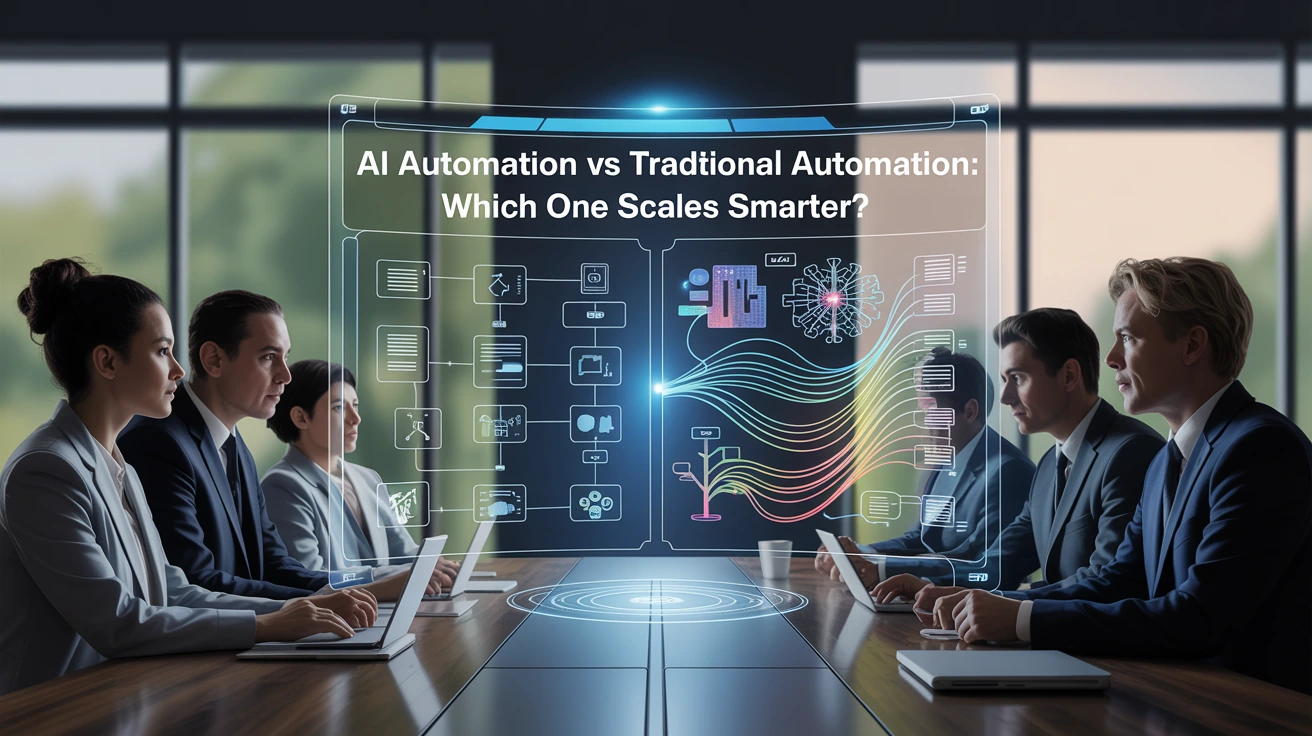
Traditional automation relies on predefined rules and fixed workflows to complete tasks.
It works on simple logic:
Examples include:
Once configured, traditional automation performs the same task the same way every time.
AI automation uses machine learning, natural language processing, and decision intelligence to automate tasks that involve variation, judgment, or learning.
Instead of rules, AI automation:
Examples include:
Traditional automation is still effective when:
Examples:
For these cases, AI may add unnecessary complexity.
AI automation excels when:
Examples:
Traditional automation:
AI automation:
As scale increases, AI automation becomes more cost-efficient due to reduced manual intervention.

Choose traditional automation if:
Choose AI automation if:
In many modern businesses, a hybrid approach works best.
A-1. AI automation learns and adapts using data, while traditional automation follows fixed rules. AI handles variability better and improves over time.
A-2. AI automation is better for complex and changing workflows. Traditional automation still works well for stable, repetitive tasks.
A-3. No. Many businesses use both together, combining rule-based automation with AI for decision-making tasks.
A-4. AI automation has higher upfront costs but often delivers better long-term ROI due to scalability and reduced manual effort.
A-5. Industries like finance, healthcare, SaaS, eCommerce, and customer support benefit most due to complex data and decision-heavy workflows.
A-6. Yes. Modern AI automation tools are scalable and can be implemented gradually based on business needs.
Browse
Resources