Home / Blog / Brochure Design for Dubai Real Estate Listings: What Buyers Expect to See
Discover what Dubai buyers expect from a property brochure, from professional photography and clear floor plans to pricing, payment plans, and location details. Learn how effective layout, visual hierarchy, and brand consistency help agencies and developers create brochures that build trust and capture buyer attention.
26 Nov, 2026
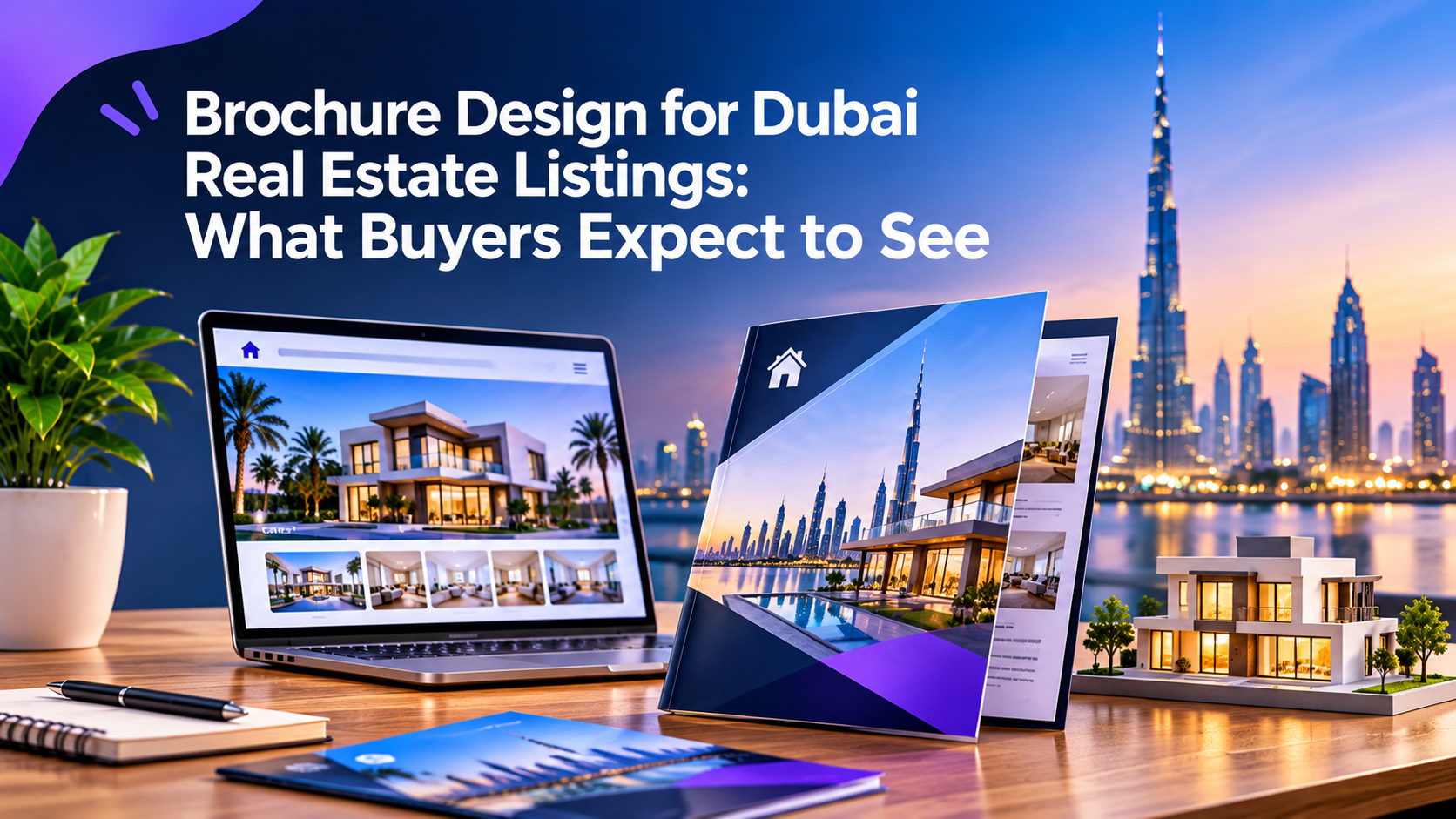
A buyer picking up a property brochure at a viewing or downloading one from a listing page usually spends under a minute deciding whether to keep reading. In that minute, they are not reading every word; they are scanning for a handful of specific things: clear photos, the price, the size, the location, and a floor plan they can actually understand. If a real estate brochure makes them hunt for any of that, it gets set aside. This article looks at what Dubai buyers expect to see in a property brochure and where agencies and developers most often lose their attention.
Property portals and virtual tours have changed how listings are discovered, but the brochure still does a job those channels don't: it's the document a buyer keeps after the viewing, forwards to a partner or investor, or hands to a lawyer during due diligence. A well-designed brochure also signals how seriously a developer or agency treats the sale; a rushed, text-heavy layout can quietly undermine confidence in a high-value purchase, even if the property itself is strong.
For developers and agencies handling multiple listings, consistency across brochures also matters. The same principles used in [professional catalog design] can help organize property information, imagery, specifications, and comparison points without making the document feel overloaded.
Before reading a single line, a buyer's eye goes to the largest image and the boldest number on the page. That's usually the hero photo and the price or starting price. A good brochure layout puts these front and center on the cover or first spread, then uses a consistent visual hierarchy headline, subheading, body copy, and callouts to guide the eye through unit types, amenities, and location details in a logical order. Cluttered layouts with too many competing fonts or crowded photo grids make buyers work harder than they're willing to.
The overall design should also support the property's positioning. A luxury development, for example, may need more restrained typography and spacious layouts, while a family-focused community may benefit from clearer information blocks and practical visual cues. The goal is not to decorate every page but to make important information easy to find.
Two elements consistently determine whether a buyer trusts a brochure: photography quality and floor plan clarity. Photos need to be well-lit, professionally shot (not phone snapshots), and representative of the actual unit or a genuinely comparable one buyers notice when renders don't match delivered units. Floor plans should show room dimensions, orientation, and layout at a glance; a plan that's too small to read or missing key measurements forces the buyer to ask questions the brochure should have already answered.
For a property-focused brochure, visuals should work together rather than compete with each other. Exterior photography, interiors, amenities, maps, and floor plans should each have a clear purpose. This is especially important when the brochure is being viewed digitally on a phone or tablet.

Beyond photos, most buyers are checking for a specific set of facts: unit size in square feet, price or price range, number of bedrooms and bathrooms, building or community amenities, payment plan (common in Dubai's off-plan market), handover date, and location relative to landmarks, schools, or transport. Brochures that bury this information in paragraphs of marketing language, rather than presenting it in a scannable table or callout box, tend to lose buyers who are comparing multiple listings side by side.
Location information deserves particular attention in Dubai. Instead of simply naming the community, a brochure can make the information more useful by showing nearby roads, metro stations, schools, shopping destinations, business districts, beaches, or other relevant landmarks. A simple location graphic can communicate this faster than several paragraphs of copy.
The most frequent issues are outdated pricing left on a printed run, floor plans that don't match the described unit, stock photography that doesn't reflect the actual development, and payment plan terms that are vague or missing entirely. In a market where buyers are often comparing several off-plan projects at once, small inconsistencies read as carelessness and can cost a lead before an agent even gets a call back.
Brand consistency is another factor worth considering. A brochure should look like it belongs to the same brand as the developer's website, signage, social media, and other marketing materials. A useful reference for this is the broader discussion around [branding, marketing, and design], where visual consistency plays an important role in how a business is perceived.
Printed brochures still earn their place at physical viewings, sales offices, and exhibitions, where a tangible document reinforces the experience. Digital versions of PDFs sent by email or WhatsApp, or brochures embedded in a listing page, need to load fast, stay legible on a phone screen, and keep the same information hierarchy as the print version.
Many Dubai agencies now produce both from a single design system, so updates to pricing or availability can be pushed to the digital version quickly while print runs are planned around major sales phases. The digital version should also use selectable text where appropriate, optimized images, working contact links, and a clear file structure so buyers can navigate it easily.
A brochure that gets the layout, photography, and information hierarchy right does more than look polished; it answers the buyer's first questions before they have to ask, which is exactly what a listing document is supposed to do.
For businesses looking to create brochure design, flyers, and other marketing materials, Graphics & Design Services in Dubai can help bring the same principles of visual hierarchy, brand consistency, and readability into the final design.
Most Dubai property brochures use A4 or a similar format for single-listing pieces, with tri-fold or multi-page booklets for larger developments with multiple unit types. The right size depends on how much floor plan and amenity detail needs to be shown clearly, since cramming too much onto a small format hurts readability.
For off-plan properties, yes, Dubai buyers routinely compare payment plans across projects, so leaving this out is a common reason a brochure gets passed over. Even a simplified summary of the down payment percentage, installment schedule, and handover payment is more useful than omitting it entirely.
Brochures should be reviewed whenever pricing, availability, or handover dates change, and definitely before a new sales phase or exhibition. Outdated pricing on a printed brochure is one of the fastest ways to lose credibility with a buyer who has already checked current listings online.
Yes. A simple map showing major roads, transport links, landmarks, schools, or nearby attractions can help buyers understand the property's location quickly without reading lengthy descriptions.
Yes. A digital PDF makes it easier for buyers to receive, save, compare, and share property information through listing websites, email, and WhatsApp. It should be optimized for mobile viewing while keeping floor plans, pricing, and key details readable.
Browse
Resources